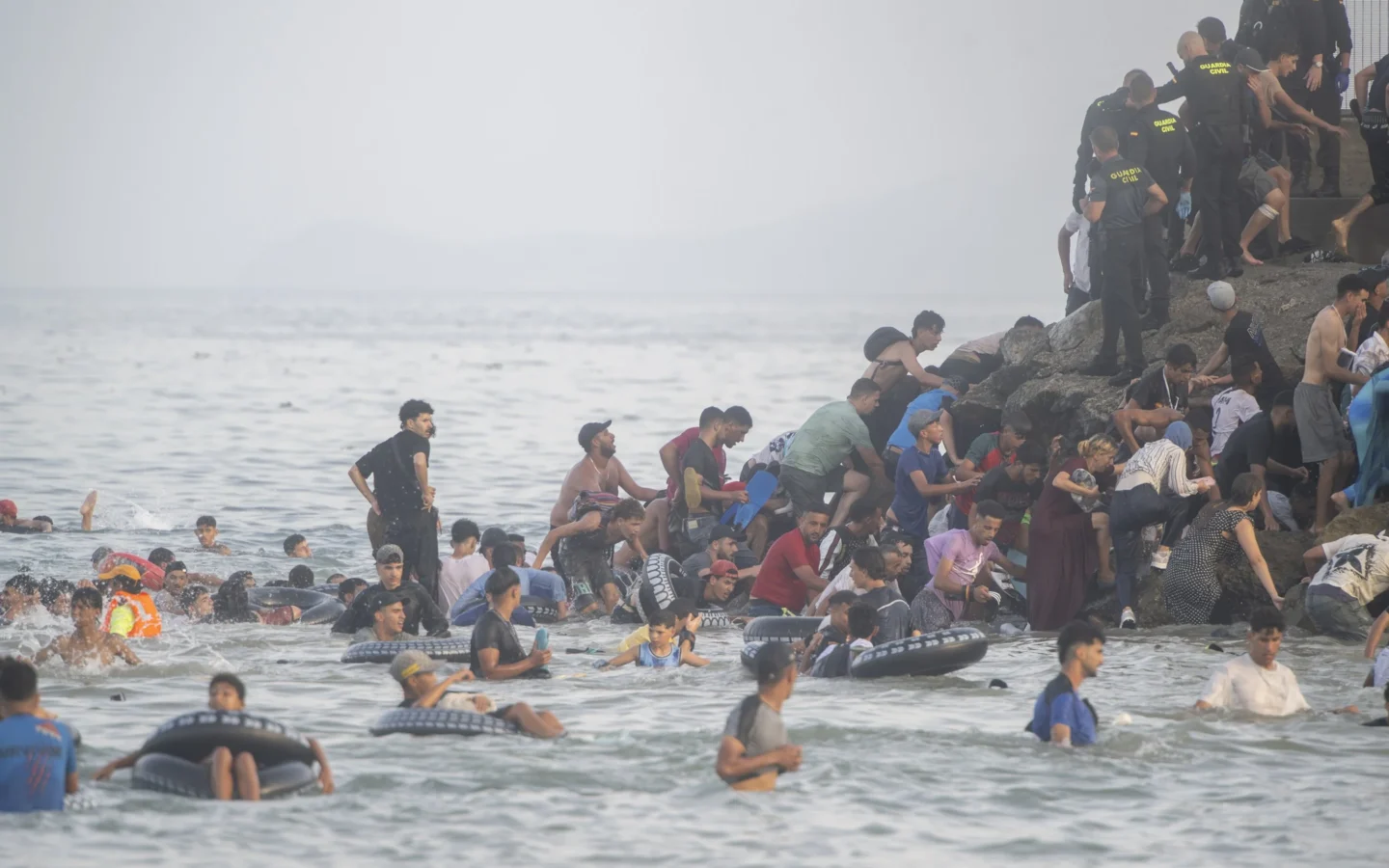
The most painful image from the Ceuta events was not only the image of young Moroccans swimming in the sea, climbing barriers, or running after reaching the other side.
For me, the real shock was how quickly everything happened.
In only a few hours, videos and messages shared on TikTok, Instagram, Facebook, and WhatsApp became a large movement of people. Thousands of young Moroccans went to Fnideq and the Ceuta border because they believed that a short opportunity had opened and could disappear at any moment.
There was no clear leader, no official organisation, and no common political message. There were only smartphones, social media rumours, videos of people reaching Ceuta, and many young people who were already ready to leave Morocco.
This is the real question we need to ask: how could one rumour move so many people in such a short time?
The easy answer is that human-trafficking networks and social media pages misled them. This may explain part of the story, but it does not explain everything. A rumour alone cannot create thousands of people who are ready to risk their lives.
A rumour can only activate a desire that already exists.
This article is also available in Arabic.
What happened in Ceuta in July 2026?
The situation started after information about a decision by Spain’s Supreme Court was shared online.
The court decision was related to migrants who reach Ceuta or Melilla by sea. On social media, the decision was presented in a very simple and misleading way. Many posts claimed that anyone who reached Ceuta by swimming could not be returned to Morocco and would receive legal papers or be moved to mainland Spain.
This was not an accurate explanation of the court decision.
The ruling did not give automatic residence, asylum, or legal status to every person who reached Ceuta. It was related to the legal process of immediate returns at the border. Spanish authorities could still use normal legal procedures to return people who had no right to stay.
But on social media, legal details do not travel as quickly as simple promises.
The message that spread was clear: swim to Ceuta now, and you may have a chance to stay in Europe.
Some young people who reached the Spanish-controlled city started publishing videos. These videos showed where they entered the sea, how they moved, what they wore, and how they avoided security points.
Each successful video encouraged more people to try.
For a young person watching from another Moroccan city, the journey started to look possible. It no longer looked like a dangerous migration route. It looked like something that ordinary people were doing successfully.
This is how social media changed the situation from individual attempts into a mass movement.
Why did the situation grow so quickly?
The Ceuta events cannot be explained by one reason. Several factors came together at the same time.
The first factor was the Spanish court decision and the false information created around it. A complex legal decision was reduced to one simple promise: reach Ceuta, and Morocco cannot take you back.
The second factor was social media. Young people did not need to contact traditional smugglers or organised migration networks. They could watch videos, receive locations, ask questions, and follow the situation live through their phones.
The third factor was fear of missing the opportunity. Many people believed that the border would soon close. They felt that they had to move immediately, without enough time to think about the danger or verify the information.
The fourth factor was the large number of young people who already wanted to leave Morocco. The court decision did not create this desire. The videos did not create it either. They only gave people a reason to act at the same time.
The fifth factor was group behaviour. A person may be afraid to swim alone, but when thousands of others are moving in the same direction, the danger can appear smaller.
The number of people created a false feeling of safety. But the sea did not become safer because more people entered it.
The problem did not begin at the Ceuta border
It is easy to describe these young people as irresponsible, naïve, or lazy. Some of them certainly made a dangerous and irrational decision. But judging them is much easier than understanding them.
The difficult question is not only why they believed a rumour.
The difficult question is why so many young Moroccans were ready to leave their homes, families, and country after watching a few videos.
Youth unemployment remains one of Morocco’s biggest social and economic problems. Many young people finish school or university without finding a stable job. Others leave education early and do not receive useful professional training.
A large number of Moroccan young people are not working, studying, or following any training programme. They spend years waiting for an opportunity that may never come.
This situation creates frustration.
A young person can see Morocco building factories, roads, airports, ports, railway lines, stadiums, and tourism projects. At the same time, that same person may not find a job that allows them to pay rent, help their family, or build an independent life.
This is where the gap starts.
The country moves forward, but part of the population does not feel that it is moving with it.
Morocco is growing, but do young people feel this growth?
Morocco is not a country without economic progress.
In recent years, the country has attracted industrial investments, developed the automotive and aerospace sectors, expanded tourism, built important infrastructure, and prepared major projects for the 2030 FIFA World Cup.
These developments are important. Morocco needs modern roads, trains, airports, hospitals, schools, factories, and digital infrastructure. A country cannot stop investing in its future.
But economic growth is not only a number in an official report.
A citizen experiences the economy through their salary, rent, food prices, transport costs, access to healthcare, education quality, and ability to find a stable job.
A young Moroccan does not live inside the gross domestic product growth rate. They live inside their monthly income.
They cannot pay rent with a new stadium. They cannot receive medical treatment inside an economic presentation. They cannot build a family with promises about future investment.
The real question is therefore not whether Morocco is growing.
The real question is who is benefiting from this growth, how quickly the benefits reach ordinary citizens, and whether young people can see a place for themselves inside the country’s economic future.
The rising cost of living
The cost of living is also an important part of the problem.
Even when inflation becomes lower, prices do not automatically return to their old levels. Many Moroccan families continue to feel pressure from food prices, rent, transport, education, electricity, water, and healthcare.
For young people, the problem is even more difficult.
Many entry-level salaries are not enough to create an independent life. A young person may find a job but still be unable to rent a home, buy a car, save money, get married, or support their parents.
This creates another form of unemployment: people may be officially employed, but their income does not give them real economic security.
When young people compare their salaries with European salaries through social media, they often see only the income difference. They do not always see taxes, housing costs, legal problems, racism, loneliness, or the difficulty of living without documents.
Europe becomes an imagined solution.
Morocco becomes the place where they feel stuck.
Social media did not create the crisis, but it made it faster
TikTok, Instagram, Facebook, and WhatsApp played a major role in the Ceuta events.
However, blaming social media alone would be another easy answer.
Social media did not create unemployment. It did not create expensive housing, weak public services, unequal opportunities, or the feeling that personal connections are sometimes more important than skills.
What social media did was make the crisis visible and faster.
In the past, a migration rumour could take days or weeks to spread. Today, a video can reach hundreds of thousands of people within hours.
The same platforms that show Moroccan success stories also show young people how others crossed borders, found work abroad, bought cars, or changed their lives.
Some of these stories are real. Others are incomplete, exaggerated, or completely false.
But for someone who has lost hope, even a false story can look more believable than another official promise.
Moroccan youth do not hate Morocco
I do not believe that every young Moroccan who wants to leave hates Morocco.
Many young people love this country. They are proud of its history, culture, football, development, and international progress. They want Morocco to succeed.
But it is possible to love your country and still feel that you cannot build your future inside it.
Many young Moroccans are not running away from Morocco as a nation. They are running away from unemployment, low salaries, expensive living costs, weak public services, social inequality, and the feeling that hard work does not always lead to a better life.
This difference is important.
Telling young people to love their country more will not solve the problem. Many of them already love it.
What they need is a reason to believe that their country also has a place for them.
My opinion as a young Moroccan
As a Moroccan, I am proud when I see my country building new roads, railway lines, factories, airports, and stadiums. I am proud when Morocco attracts investment, becomes stronger in Africa, and receives international attention.
I do not believe that Morocco should stop large projects until every social problem is solved. No country develops in this way. We need investment, infrastructure, industry, tourism, and global events.
But I also believe that every development model is incomplete when young people cannot see themselves inside it.
Infrastructure is important, but people are not a small detail in the development process.
When thousands of young people are ready to enter the sea during a period when Morocco is celebrating its achievements, we should not answer only by saying that they believed fake news.
Yes, many of them were misled.
But the lie worked because the promise of another life was stronger than their fear of the sea.
I do not support irregular migration. It is dangerous, illegal, and can end with death, detention, exploitation, or forced return. We should not present “harraga” as heroes or turn a deadly journey into a romantic adventure.
At the same time, criticism alone is not a public policy.
The state can stop one crossing attempt. It can increase security, control the roads, arrest smugglers, and monitor the border. But it cannot remove the desire to leave only through police measures.
You can close a border, but you cannot close frustration.
What should Morocco do?
There is no simple solution, but Morocco must treat youth unemployment as a national emergency, not only as a number published every few months.
Education and professional training must be connected to real needs in the job market. Young people should not spend years studying subjects that offer very few employment opportunities.
Employment programmes should be measured by stable jobs created, not only by the number of applications, loans, training sessions, or beneficiaries announced.
Large projects linked to the 2030 World Cup should also create clear opportunities for local workers, small companies, young professionals, and students.
Moroccans need to know who benefits from these investments, how many long-term jobs they create, and what remains for local communities after the event ends.
Official communication must also become faster.
A false rumour can spread in minutes. An official statement that arrives one day later may already be useless. Public institutions need to communicate on TikTok, Instagram, YouTube, and WhatsApp in a simple language that young people understand.
But communication alone is not enough.
The most important task is rebuilding trust.
A young person who believes in their future will not run to the border because of one TikTok video. A person who sees a realistic path towards employment, housing, dignity, and stability will think carefully before risking everything.
Ceuta is not only the problem. It is the mirror
The Ceuta events can be seen as a border crisis, an irregular migration problem, a result of misinformation, or a legal issue between Morocco and Spain.
All these elements are part of the story.
But Ceuta was also a mirror.
It showed us youth unemployment, frustration, the power of social media, the pressure of living costs, and the distance between national economic progress and personal economic reality.
Morocco’s biggest loss is not only that a young person crosses the border.
The biggest loss is when a young Moroccan stops believing that their future can begin in Morocco.
Borders can be protected with police officers, cameras, fences, and security forces.
Hope can only be protected with fair opportunities, good education, accessible healthcare, decent work, and trust.
Without these things, the next rumour may be different, the route may be different, and the destination may be different.
But the desire to leave will remain.