Do you know how you can tell your mother’s voice from ten other voices in one room?
You cannot explain how. You just know. There is no list of voice specifications in your head that you go through, yet the recognition happens in a fraction of a second.
Neural networks are an attempt to build something that works on this logic: no written rules, but a network of simple connections that come together to produce a result.
What is a neural network?
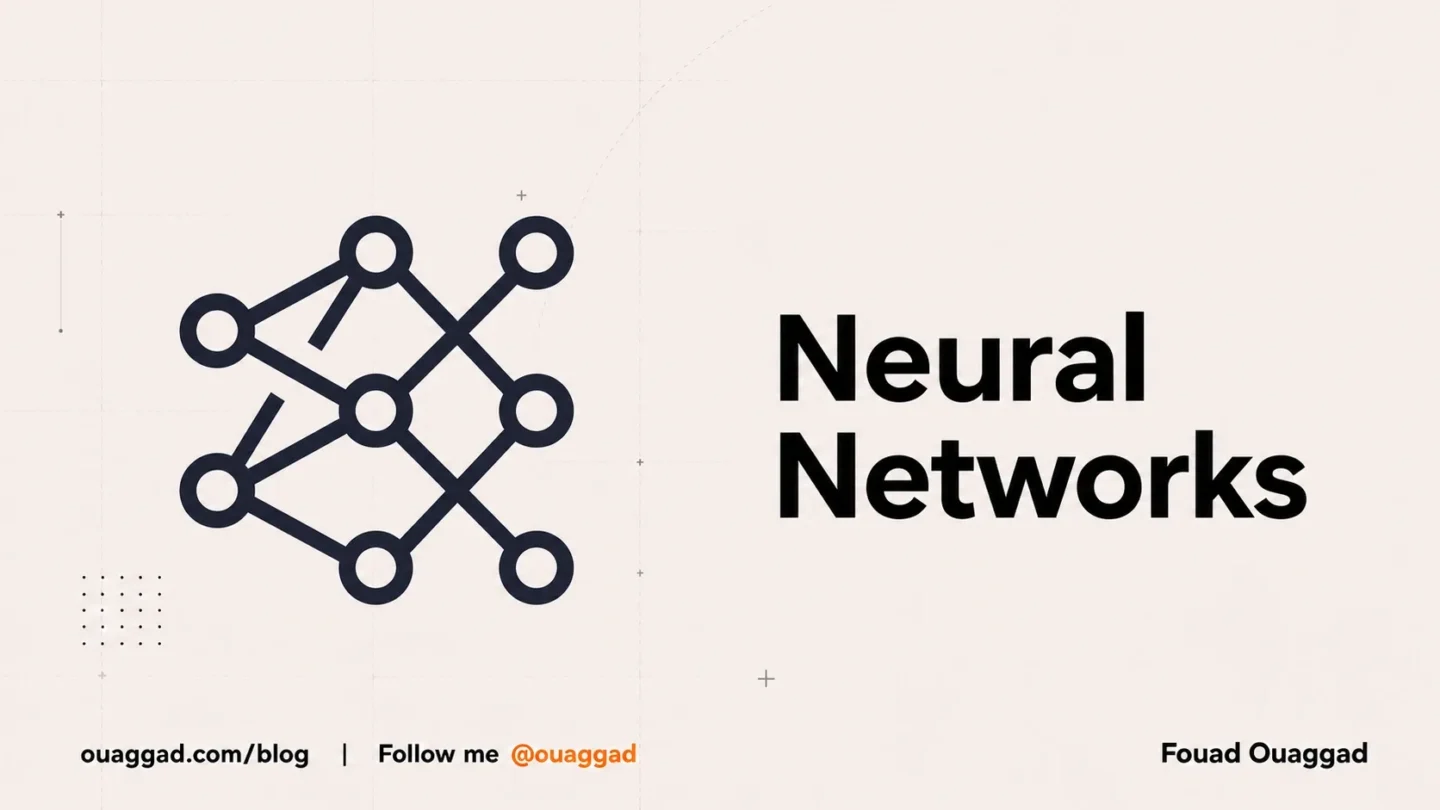
An artificial neural network is a way of organizing the calculations inside a program as connected nodes spread over layers.
Each node does something very simple: it receives numbers, adds them up with different weights, and decides whether to pass a signal to the next nodes or not.
One node is worth nothing. But thousands of connected nodes can capture extremely complex patterns.
Why is the name taken from the brain?
Because the idea was inspired by nerve cells: a cell receives signals, and if they pass a certain threshold, it fires a signal to the next cells.
But the comparison stops there, and it is important to know its limits.
A real nerve cell is far more complex than a mathematical node. And the human brain learns from few examples, connects distant fields, and knows when it does not know. The artificial network does none of this.
The name is an old metaphor that stuck, and it has caused more confusion than it has explained.
What do “weights” mean?
A weight is a number that decides how important a particular signal is.
Imagine you are deciding which car to buy. The price matters a lot to you, the color matters a little, the color of the seats means nothing. You are giving each factor a different weight without calling it that.
The network does the same thing with numbers. And training is nothing more than adjusting these weights again and again until the results are right.
When you hear that a model has “billions of parameters,” this is what they are: billions of tuned weights.
What is the problem with it?
It is a closed box.
If a system built on a neural network rejects a loan application, it is very hard to know exactly why. The decision is spread across millions of weights, and there is no single rule you can point to.
This is not only a technical problem. In hiring, lending, courts, and medicine, “we do not know why” is not an acceptable answer.
This is why there is now an entire field trying to make these systems explainable.
In short
A neural network is not a digital brain. It is a mathematical structure that learns by tuning millions of numbers until its errors go down.
It is astonishingly powerful at capturing patterns, and annoyingly opaque when we ask it: why?
The power and the opacity here are two sides of one coin. It is good precisely because it does not rely on rules we understand.