Imagine you want to teach a computer how to recognize cats in photos.
You could try to describe a cat to it: two ears, whiskers, four legs. But what if the photo is dark? Or the cat is curled inside a box with only its head showing?
You will quickly discover that writing a rule for every possibility is impossible.
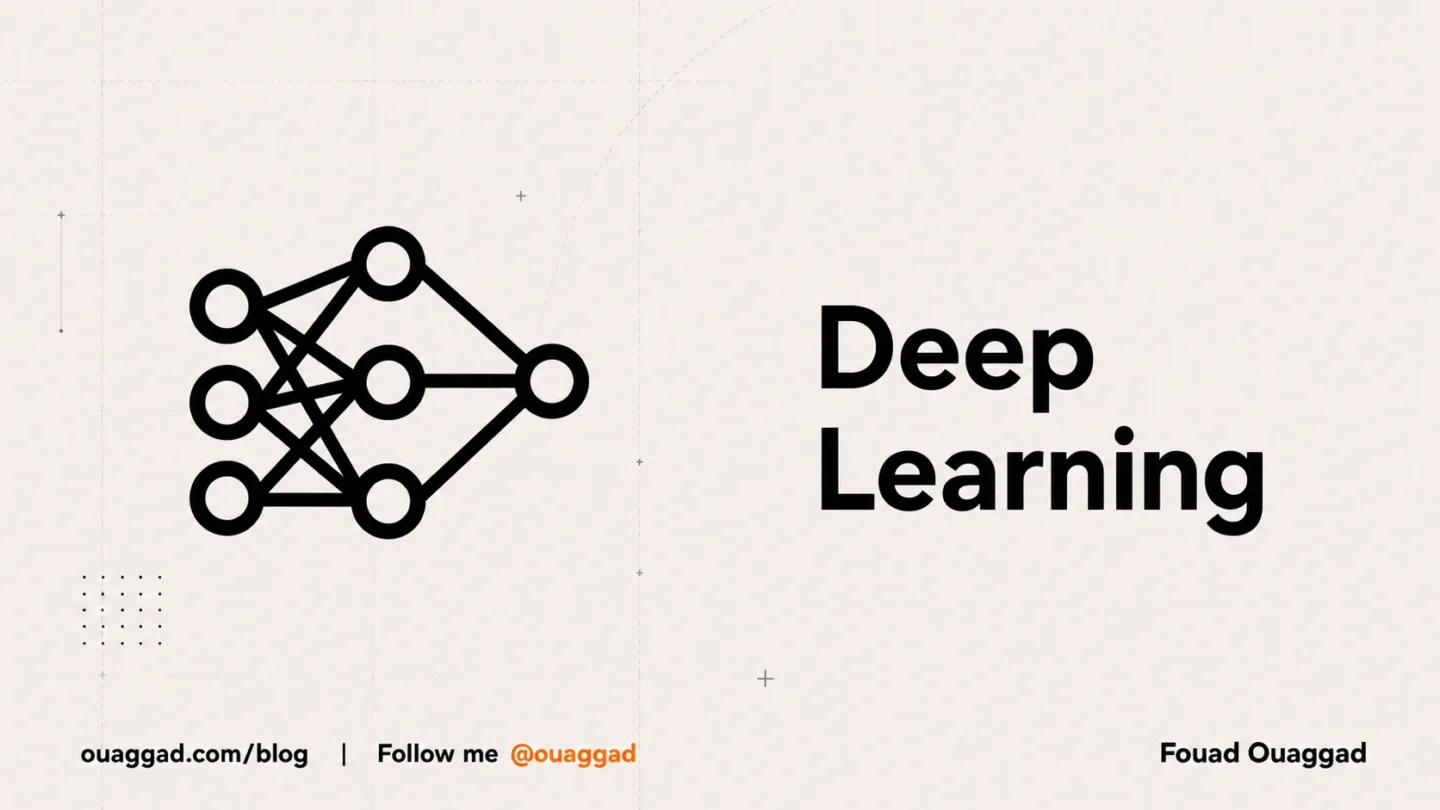
Deep learning solves this in a completely different way: instead of a list of rules, layers.
What is deep learning?
Deep learning is an advanced type of machine learning that passes information through successive layers, where each layer understands a small part and hands it to the next one.
In the cat example: the first layer sees only lines and edges. The next one combines those lines into shapes: a circle, a triangle. Another layer combines the shapes into an ear or an eye. And at the end, all the signals come together to say: this is a cat.
No single layer knows what a cat is. The knowledge is spread across the whole path.
Why is it called “deep”?
Not because it thinks deeply. The word describes the number of layers, not the quality of the thinking.
A network with three layers is shallow. A network with a hundred layers is deep. That is all it means.
This is one of many cases where a technical term was chosen that suggests more than it actually says.
How does it learn?
Like a student who solves an exercise and then sees the correction.
We show it an image, and it says: dog. We tell it: wrong. So it goes back through its layers to find which part contributed to the error, and adjusts it slightly.
Then another image, another correction. Millions of times.
After a long stretch of this, the layers become tuned so that they give the right answer in most cases.
How is it different from ordinary machine learning?
In traditional machine learning, a human decides what should be looked at. If we want to predict the price of a house, we tell the system: look at the size, the location, and the number of rooms.
In deep learning, the system works out for itself what is worth looking at. This is what made it succeed with images, audio, and text, where we do not even know how to describe what should be noticed.
But it is not always the better choice. If the data is limited or the problem is clear, a simpler model will be faster and easier to understand — and you will know why it made its decision, which is hard with deep networks.
Where do we find it?
In face recognition, speech to text, translation, film recommendations, and the analysis of some medical images.
And it is the foundation on which large language models and image generators were built. Everything you call “generative AI” today rests on it.
In short
Deep learning is what let machines handle images, sound, and language at a level that was not possible ten years ago.
But the depth here is in the number of layers, not in understanding. The system captures very complex patterns in data, and that is completely different from knowing what it is looking at.